Few questions start arguments among anime fans faster than “sub or dub?” The same debate now applies to K-dramas, Spanish thrillers, Scandinavian crime series and almost every international hit on streaming services. The truth is less dramatic than the comment sections suggest: both are valid ways to watch, and the best choice depends on the show, the screen and what you want from the experience.
This guide explains what each term means, the real strengths and trade-offs of each, and a simple way to decide.
What do subbed and dubbed mean?
- Subbed (subtitled) means you hear the original voice cast in the original language, with a translation shown as text on screen.
- Dubbed means the dialogue has been re-recorded by voice actors in another language, so you can listen without reading.
You will also see CC or SDH subtitles. These are captions designed for viewers who are deaf or hard of hearing, and they include sound effects and speaker names as well as dialogue. They are useful for anyone watching with the volume low.
The case for watching subbed
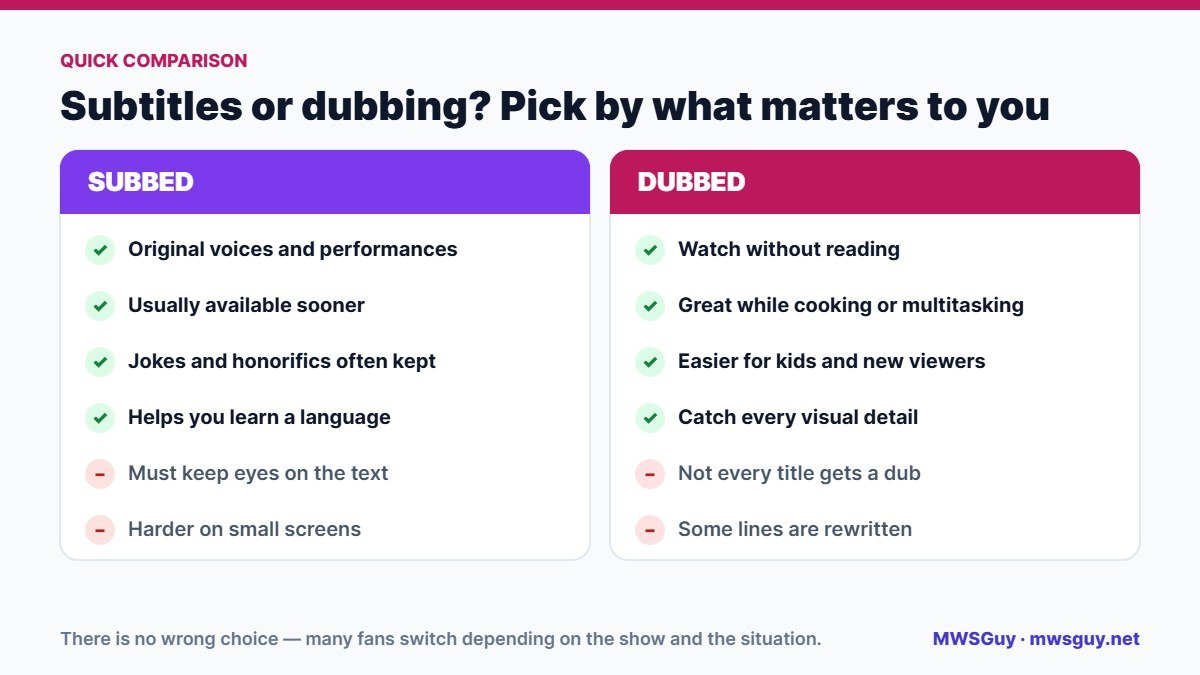
- You hear the original performance. The voice cast worked directly with the director, and tone, timing and emotion are exactly as intended.
- It is often available first. For many new anime and international series, subtitled episodes arrive before dubbed versions — sometimes the same day as the original broadcast.
- Cultural details survive. Honorifics, wordplay and references are more likely to be kept, sometimes with translator notes.
- It can support language learning. Hearing natural speech while reading the meaning is a low-effort way to pick up words and rhythm.
The downsides: you need to keep your eyes on the bottom of the screen, which can mean missing visual details in fast action scenes, and small text on a phone can be tiring.
The case for watching dubbed
- You can watch the whole picture. Without reading, it is easier to take in animation, choreography and background details.
- It suits relaxed viewing. Dubs are ideal when you are cooking, folding laundry or watching with friends who are not paying full attention.
- It is easier for some viewers. Children, people with reading difficulties or visual impairments, and those new to a genre often find dubs more accessible.
- Quality has improved a lot. Many modern dubs use experienced voice casts and careful scripts, and some are considered classics in their own right.
The trade-offs: not every title gets a dub, dubs may arrive later, and some lines are rewritten so they match lip movements or sound natural. That can change the meaning slightly.
Subbed vs dubbed at a glance
| Subbed | Dubbed | |
|---|---|---|
| Original voice acting | Yes | No (new voice cast) |
| Reading required | Yes | No |
| Availability for new episodes | Usually sooner | Often later or not at all |
| Best for | Focused viewing, purists, language learners | Multitasking, kids, group viewing, accessibility |
| Translation style | Often closer to the original | Adapted to sound natural when spoken |
How to choose: a simple decision guide
- Are you giving the show your full attention? If yes, try subbed. If you are multitasking, choose dubbed.
- Is it a dialogue-heavy drama or comedy? Original voices often land better. Action-heavy shows can be easier dubbed.
- Are you watching with others? Pick whatever everyone can follow comfortably.
- Did you like the first episode? If one version feels off, switch. Many fans watch some shows subbed and others dubbed.
Tips for a better subtitle experience
- Increase the subtitle size and add a background box in your app or device accessibility settings.
- Choose the right track: “English” and “English (CC)” are often different translations.
- On a TV, sit a little closer than usual for the first few episodes until reading feels automatic.
- If subtitles drift out of sync, restart the episode or the app before blaming the show.
New to anime? Our beginner’s guide to anime genres helps you find a series that matches your taste, and how to choose what to watch next works for any kind of show. If playback keeps stopping, try our buffering fixes.
Frequently asked questions
Is it better to watch anime subbed or dubbed?
Neither is objectively better. Subbed keeps the original voice performances and is often available sooner, while dubbed lets you watch without reading. Choose based on how closely you are watching and which version you enjoy more.
Why are subtitles and dubs sometimes different?
Subtitles and dubs are often translated separately. Dub scripts must match mouth movements and sound natural when spoken, so lines are adapted. Subtitles have space and reading-speed limits, so they are condensed.
What does “simulcast” mean?
A simulcast is an episode released internationally at or very close to the time it airs in its home country, usually with subtitles. Dubbed versions may follow later.
What is the difference between CC and regular subtitles?
Regular subtitles translate or transcribe dialogue. Closed captions (CC or SDH) also describe important sounds, music and who is speaking, which makes them helpful for viewers who are deaf or hard of hearing.
Final thoughts
Sub vs dub is not a test of how serious a fan you are. It is a choice about how you want to watch today. Try the first episode both ways if you can, keep the version that lets you enjoy the story, and do not be afraid to switch for the next series.